> ## Documentation Index
> Fetch the complete documentation index at: https://headgate.mintlify.site/llms.txt
> Use this file to discover all available pages before exploring further.
# Dead-letter queue
> Understand archived jobs, inspect failures, redrive safely, and configure retention.
Headgate's `archived` job state **is the dead-letter queue (DLQ)**. There is no second
active queue or `dead_jobs` table. When a job enters `archived`, it remains in the ordinary
job store with the same ID, payload, metadata, attempt history, and errors until its
terminal retention expires.
Keeping the dead letter as a state avoids a move between two stores and lets the same
bounded inspection and control API search, diagnose, and redrive the job.
`archived` is not the optional SQL cold archive. An archived job is still hot,
inspectable, and redrivable. A cold-archive row is retained for long-term audit after the
hot job expires and is not part of normal job inspection or admission.
## What enters the DLQ
| Cause | Terminal state | Meaning |
| ------------------------------------------------------ | -------------- | --------------------------------------- |
| A returned failure consumes the last permitted attempt | `archived` | Automatic retries are exhausted |
| A handler returns `skip` | `archived` | The handler deliberately stops retrying |
| The absolute job deadline elapses | `archived` | The work is no longer useful |
Several terminal-looking states are deliberately separate because they need different
operator responses:
| State | Why it is not the DLQ | Recovery |
| ------------- | ------------------------------------------------------------------ | --------------------------------------------------------------- |
| `quarantined` | Repeated crashes identify a possible poison-pill fingerprint | Diagnose the crash and release the fingerprint from Quarantine |
| `undecodable` | The payload version or resumable-step definition is incompatible | Deploy an upcaster or compatible handler, or repair the payload |
| `cancelled` | An operator intentionally stopped the job | Keep it for audit or enqueue replacement work |
| deleted | A handler returned `revoke`, or terminal retention removed the row | It cannot be redriven from Headgate |
Returned errors increment `attempt`; process loss and expired leases increment
`crash_attempt`. A crashing job can therefore reach `quarantined` without being mislabeled
as an ordinary retry-exhausted dead letter.
## Inspect archived jobs
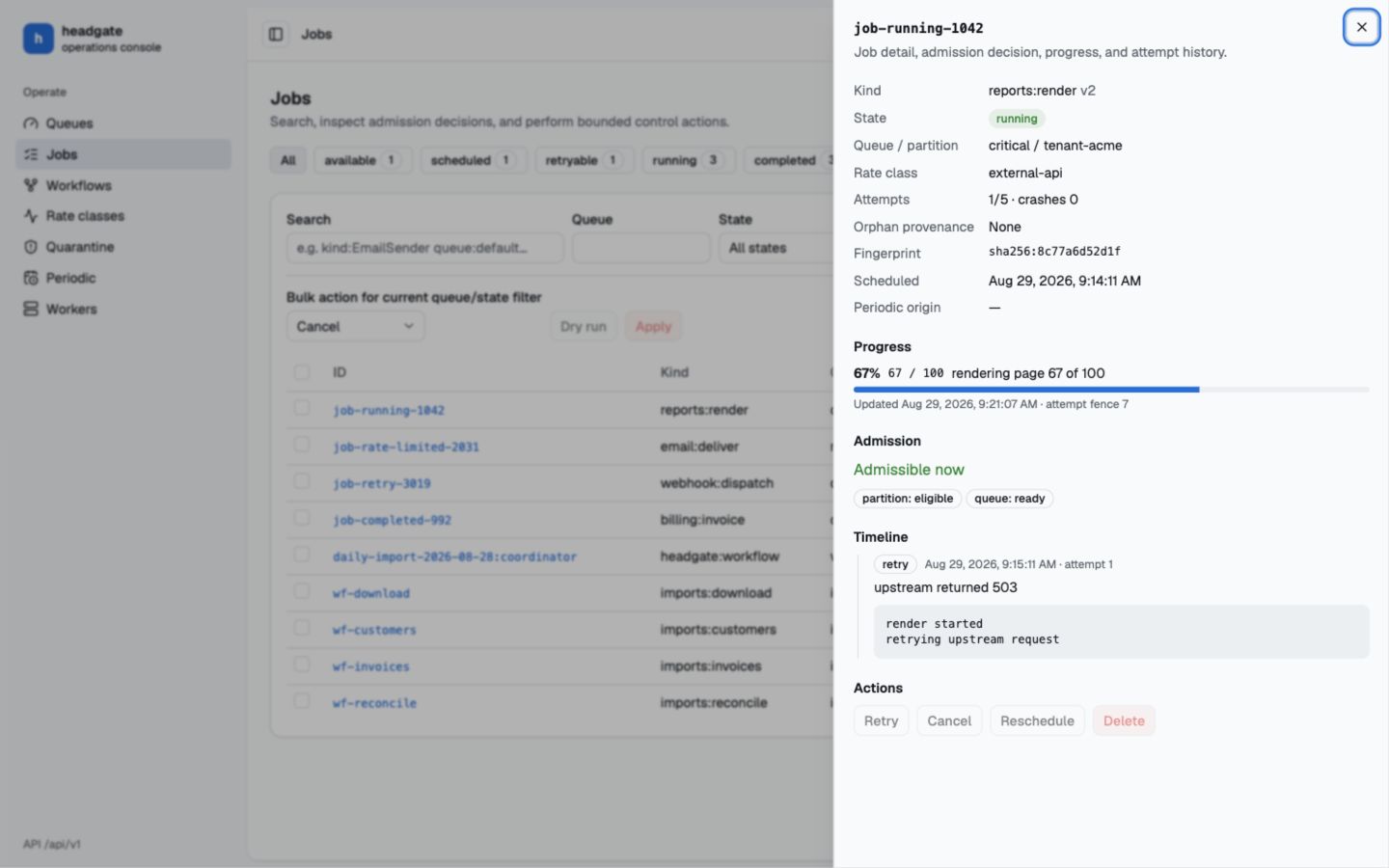
In the console, open **Jobs**, choose the **archived** state filter, and select a row. The
detail sheet keeps the job list visible and shows the error and attempt timeline, payload,
metadata, lifecycle, and available actions.
 List queries remain payload-free. Request the payload only for the job being diagnosed:
```bash theme={"system"}
curl 'http://127.0.0.1:8080/api/v1/jobs?state=archived&limit=50'
curl 'http://127.0.0.1:8080/api/v1/jobs/JOB_ID?include_payload=true'
```
Payloads and metadata may contain personal data or credentials. Protect both the control
API and console with operator authentication, and grant payload inspection separately when
your application needs a narrower role.
## Redrive after fixing the cause
Retry is defined only for `archived → available`. It preserves the job's identity,
attempt counters, errors, and other history, clears finalization, and makes the job
eligible for admission immediately. Because history is preserved, another returned
failure can archive it again; redrive is not a way to erase an exhausted retry budget.
For one job, use the Retry action in its console sheet, the CLI, or the control API:
```bash theme={"system"}
headgatectl --api http://127.0.0.1:8080 jobs retry JOB_ID
curl --request POST \
--header 'Idempotency-Key: redrive-JOB_ID-1' \
'http://127.0.0.1:8080/api/v1/jobs/JOB_ID/retry'
```
For a reviewed set of at most 1,000 jobs, select their checkboxes in the console or send
the explicit IDs. The response reports success or failure for each ID:
```bash theme={"system"}
curl --request POST \
--header 'Content-Type: application/json' \
--header 'Idempotency-Key: billing-redrive-2026-08-31' \
--data '{"action":"retry","ids":["JOB_1","JOB_2"]}' \
'http://127.0.0.1:8080/api/v1/jobs/actions'
```
For a larger set, use the asynchronous bulk operation. Start with `dry_run: true`, review
the matched count, then submit the same non-empty selector with a new idempotency key and
`dry_run: false`:
```bash theme={"system"}
curl --request POST \
--header 'Content-Type: application/json' \
--header 'Idempotency-Key: billing-redrive-preview-1' \
--data '{
"action":"retry",
"selector":{"state":"archived","queue":"billing"},
"dry_run":true
}' \
'http://127.0.0.1:8080/api/v1/jobs/bulk'
```
The bulk route returns an operation ID to poll at `GET /api/v1/operations/{id}`. Empty
selectors are rejected, and the operation processes matches in bounded batches instead of
holding one request open for the whole queue depth.
Repair the root cause before redriving. A transient dependency outage may need no job
change. Bad input may need `PUT /api/v1/jobs/{id}/payload` before retry. An incompatible
schema belongs in `undecodable`, not `archived`, and must be fixed through payload
versioning or an upcaster.
## Use death handlers for notification
A death handler runs once per successful fence-verified transition to `archived`. A job
that is redriven and later archived again produces a new death event. The handler receives
the job snapshot, terminal error, and one of `attempts_exhausted`, `skipped`, or
`deadline_exceeded`. Use it for alerts, metrics, or an incident record—not for deciding
whether the archive transition is allowed.
```rust Rust theme={"system"}
use headgate::{DeathHandlerFn, WorkerConfig};
use std::sync::Arc;
let notify = DeathHandlerFn::new(|event: &headgate::DeathEvent| {
tracing::error!(
job_id = %event.envelope().id,
reason = ?event.reason(),
error = event.error(),
"job entered the dead-letter queue"
);
});
let worker_config = WorkerConfig {
death_handlers: vec![Arc::new(notify)],
..WorkerConfig::default()
};
```
```go Go theme={"system"}
runnerConfig.DeathHandlers = append(
runnerConfig.DeathHandlers,
headgate.DeathHandlerFunc(func(ctx context.Context, event headgate.DeathEvent) {
slog.ErrorContext(ctx, "job entered the dead-letter queue",
"job_id", event.Envelope().ID,
"reason", event.Reason(),
"error", event.ErrorMessage(),
)
}),
)
```
Death handlers run synchronously in registration order inside the worker, after the durable
store write. A process can die after archiving and before sending an external notification,
so do not treat the callback as a transactional outbox. Callback code should tolerate
application-level duplicates, and durable alerting should reconcile from
`state=archived` inspection.
## Choose retention deliberately
`retention_ms` controls how long a terminal job stays in the hot store. Configure a
positive window long enough for your on-call and redrive process; once the hot row is
removed, the ordinary retry operation no longer has a job to restore.
PostgreSQL and MySQL can copy selected queues into monthly cold-archive partitions during
the bounded retention sweep. Those rows are for audit and later pruning, not admission or
redrive. Redis supports terminal retention but does not claim SQL cold-archive partitions.
| Storage | Search with `state=archived` | Redrive | Purpose |
| ---------------- | ---------------------------- | ------- | ----------------------------------- |
| Hot archived job | Yes | Yes | Operational DLQ |
| SQL cold archive | No | No | Long-term audit after hot retention |
List queries remain payload-free. Request the payload only for the job being diagnosed:
```bash theme={"system"}
curl 'http://127.0.0.1:8080/api/v1/jobs?state=archived&limit=50'
curl 'http://127.0.0.1:8080/api/v1/jobs/JOB_ID?include_payload=true'
```
Payloads and metadata may contain personal data or credentials. Protect both the control
API and console with operator authentication, and grant payload inspection separately when
your application needs a narrower role.
## Redrive after fixing the cause
Retry is defined only for `archived → available`. It preserves the job's identity,
attempt counters, errors, and other history, clears finalization, and makes the job
eligible for admission immediately. Because history is preserved, another returned
failure can archive it again; redrive is not a way to erase an exhausted retry budget.
For one job, use the Retry action in its console sheet, the CLI, or the control API:
```bash theme={"system"}
headgatectl --api http://127.0.0.1:8080 jobs retry JOB_ID
curl --request POST \
--header 'Idempotency-Key: redrive-JOB_ID-1' \
'http://127.0.0.1:8080/api/v1/jobs/JOB_ID/retry'
```
For a reviewed set of at most 1,000 jobs, select their checkboxes in the console or send
the explicit IDs. The response reports success or failure for each ID:
```bash theme={"system"}
curl --request POST \
--header 'Content-Type: application/json' \
--header 'Idempotency-Key: billing-redrive-2026-08-31' \
--data '{"action":"retry","ids":["JOB_1","JOB_2"]}' \
'http://127.0.0.1:8080/api/v1/jobs/actions'
```
For a larger set, use the asynchronous bulk operation. Start with `dry_run: true`, review
the matched count, then submit the same non-empty selector with a new idempotency key and
`dry_run: false`:
```bash theme={"system"}
curl --request POST \
--header 'Content-Type: application/json' \
--header 'Idempotency-Key: billing-redrive-preview-1' \
--data '{
"action":"retry",
"selector":{"state":"archived","queue":"billing"},
"dry_run":true
}' \
'http://127.0.0.1:8080/api/v1/jobs/bulk'
```
The bulk route returns an operation ID to poll at `GET /api/v1/operations/{id}`. Empty
selectors are rejected, and the operation processes matches in bounded batches instead of
holding one request open for the whole queue depth.
Repair the root cause before redriving. A transient dependency outage may need no job
change. Bad input may need `PUT /api/v1/jobs/{id}/payload` before retry. An incompatible
schema belongs in `undecodable`, not `archived`, and must be fixed through payload
versioning or an upcaster.
## Use death handlers for notification
A death handler runs once per successful fence-verified transition to `archived`. A job
that is redriven and later archived again produces a new death event. The handler receives
the job snapshot, terminal error, and one of `attempts_exhausted`, `skipped`, or
`deadline_exceeded`. Use it for alerts, metrics, or an incident record—not for deciding
whether the archive transition is allowed.
```rust Rust theme={"system"}
use headgate::{DeathHandlerFn, WorkerConfig};
use std::sync::Arc;
let notify = DeathHandlerFn::new(|event: &headgate::DeathEvent| {
tracing::error!(
job_id = %event.envelope().id,
reason = ?event.reason(),
error = event.error(),
"job entered the dead-letter queue"
);
});
let worker_config = WorkerConfig {
death_handlers: vec![Arc::new(notify)],
..WorkerConfig::default()
};
```
```go Go theme={"system"}
runnerConfig.DeathHandlers = append(
runnerConfig.DeathHandlers,
headgate.DeathHandlerFunc(func(ctx context.Context, event headgate.DeathEvent) {
slog.ErrorContext(ctx, "job entered the dead-letter queue",
"job_id", event.Envelope().ID,
"reason", event.Reason(),
"error", event.ErrorMessage(),
)
}),
)
```
Death handlers run synchronously in registration order inside the worker, after the durable
store write. A process can die after archiving and before sending an external notification,
so do not treat the callback as a transactional outbox. Callback code should tolerate
application-level duplicates, and durable alerting should reconcile from
`state=archived` inspection.
## Choose retention deliberately
`retention_ms` controls how long a terminal job stays in the hot store. Configure a
positive window long enough for your on-call and redrive process; once the hot row is
removed, the ordinary retry operation no longer has a job to restore.
PostgreSQL and MySQL can copy selected queues into monthly cold-archive partitions during
the bounded retention sweep. Those rows are for audit and later pruning, not admission or
redrive. Redis supports terminal retention but does not claim SQL cold-archive partitions.
| Storage | Search with `state=archived` | Redrive | Purpose |
| ---------------- | ---------------------------- | ------- | ----------------------------------- |
| Hot archived job | Yes | Yes | Operational DLQ |
| SQL cold archive | No | No | Long-term audit after hot retention |